How to count a court deadline without tripping over a holiday
How US federal courts, California and England and Wales count filing deadlines, with worked examples around Thanksgiving, court days and New Year, plus a free calculator that shows every step.

Counting days sounds like the easy part of a deadline. Then the last day lands on Thanksgiving, or the period is in court days, or the papers went by post, and the answer depends on which court you are in.
I built a free court deadline calculator for US federal courts, California state courts and the courts of England and Wales. To build it I had to read each counting rule line by line. This post explains how each court counts, with real dates from the calculator, in plain words.
It is a guide, not legal advice. Local rules and court orders can change a date, so check the result against the rule and the court’s own calendar before you rely on it.
The method all three courts share
- Leave out the day of the event that starts the clock.
- Count the days in the period.
- If the last day falls on a day the court is closed, move to the next day it is open.
The courts differ on step 2, which days you count, and on step 3, which days count as closed.
US federal courts: every day counts
Under Rule 6(a)(1) of the Federal Rules of Civil Procedure, you count every day in the period, including Saturdays, Sundays and legal holidays in the middle. Only the last day can move. If it is a weekend or a legal holiday, the period runs to the end of the next day that is not.
Take 10 days from Monday, November 16, 2026. Day 10 is Thursday, November 26, which is Thanksgiving. The deadline moves to Friday, November 27.
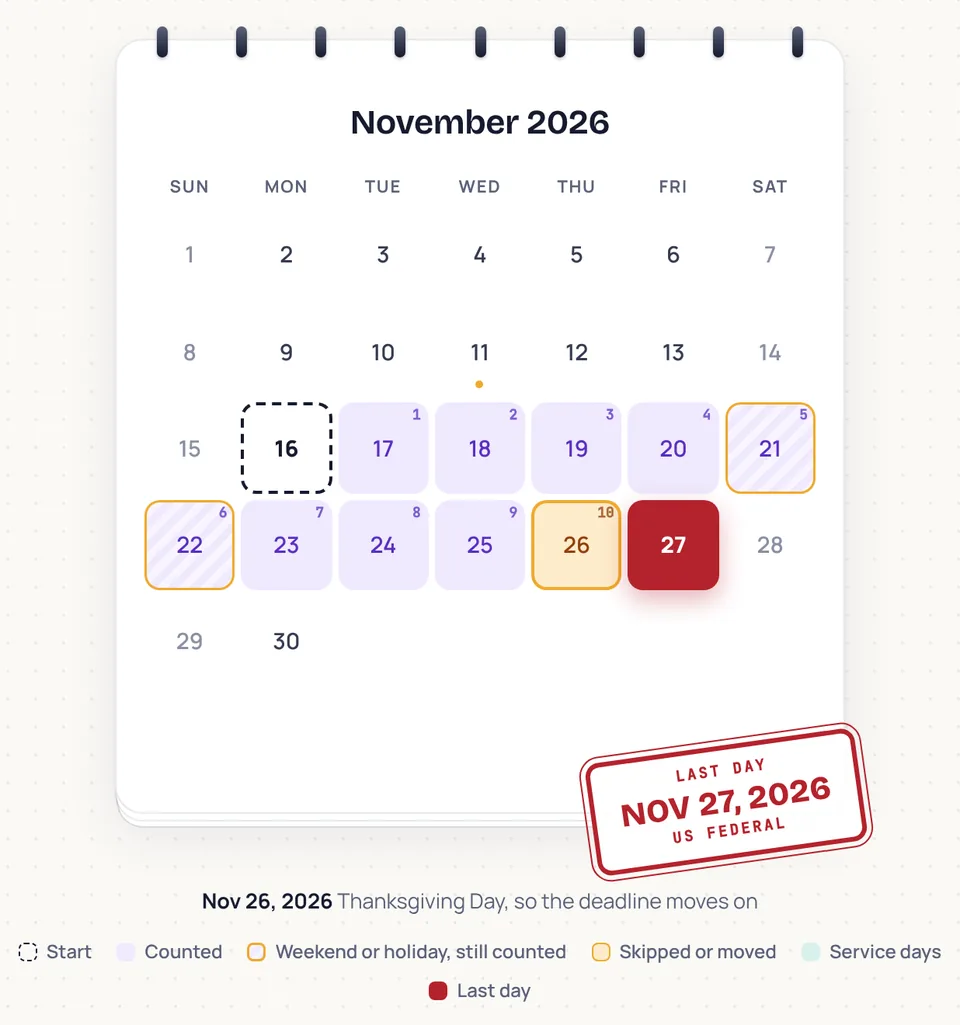
The weekend of November 21 and 22 is counted, and that is the part people tend to get wrong. Before the rules changed in 2009, periods under 11 days left weekends and holidays out, so an old habit can give the wrong date.
If the papers were served by mail, Rule 6(d) adds 3 days after the period would otherwise end. In the example, that takes the deadline from Friday, November 27 to Monday, November 30. Electronic service does not get the extra 3 days.
Rule 6(a)(6)(C) also treats any holiday declared by the state where the district court sits as a legal holiday. The calculator covers federal holidays, so add any state holiday as an extra closure day.
California: calendar days or court days
California’s Code of Civil Procedure section 12 starts the same way: leave out the first day and include the last. If the last day is a holiday, section 12a moves it to the next day that is not. Saturdays, Sundays and the judicial holidays in section 135 all count as holidays here.
Many California deadlines are written in court days instead. A court day is a day the court is open, so you skip weekends and judicial holidays as you count. Motion papers are the common example: section 1005(b) says they must be filed and served at least 16 court days before the hearing.
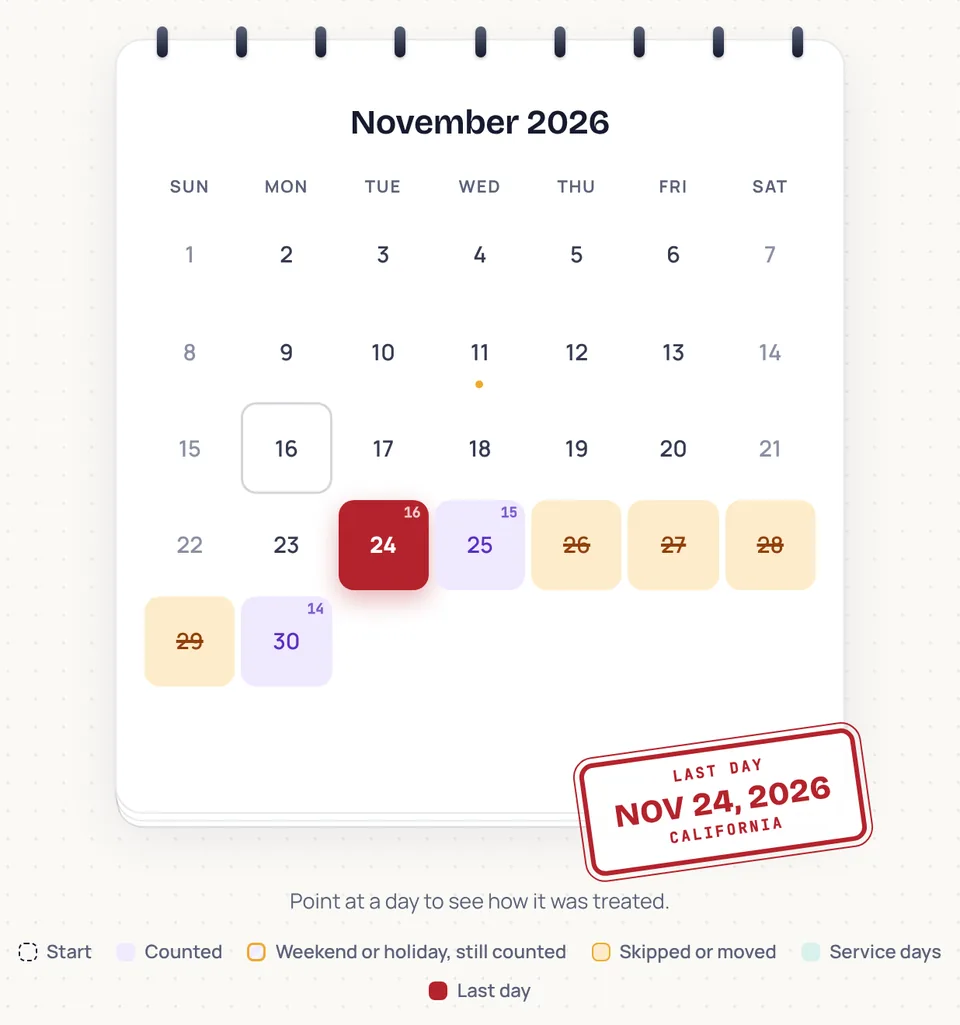
For a hearing on Friday, December 18, 2026, counting 16 court days back skips the weekends, Thanksgiving and the day after Thanksgiving, which is also a California judicial holiday. The last day to file and serve is Tuesday, November 24.
Service adds time in California too, and the amount depends on the method. Section 1013(a) adds 5 calendar days for mail within California, 10 for mail to another state and 20 for mail outside the US. Section 1010.6 adds 2 court days for electronic service. Some deadlines are not extended, the time to file a notice of appeal being one, so check the rule for yours.
England and Wales: clear days and short periods
CPR 2.8 counts in clear days. You leave out the day the period starts, and when the period ends with an event, such as a hearing, you leave out that day too.
For a period of 5 days or less, you also leave out Saturdays, Sundays, bank holidays, Christmas Day and Good Friday. Longer periods count every day. If the time for doing something at the court office ends on a day the office is closed, you are in time if you do it on the next day it is open (CPR 2.8(5)).
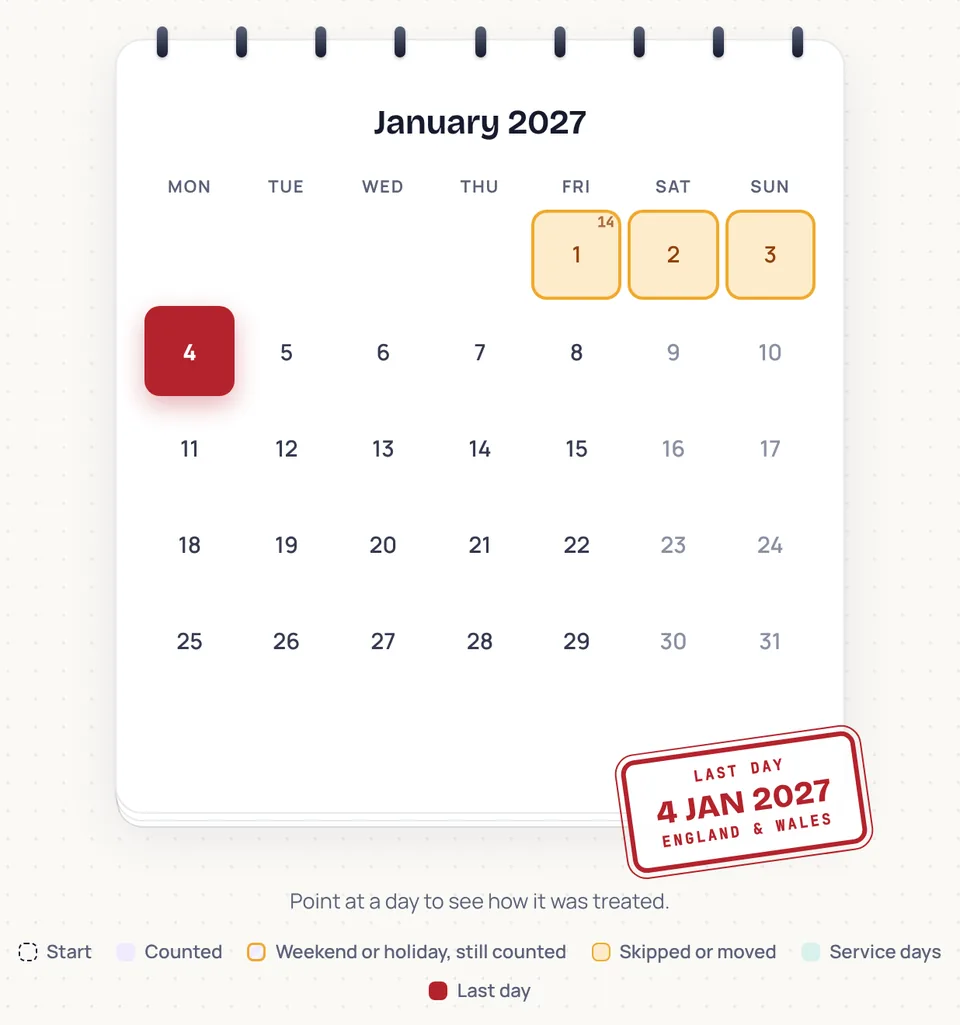
Take 14 days from Friday, 18 December 2026. Day 14 is Friday, 1 January 2027, New Year’s Day, so the step can be taken on Monday, 4 January.
With a 5 day period from the same date, the answer is Tuesday, 29 December. Christmas Day, the weekend and the Boxing Day substitute bank holiday on Monday 28 December are all left out.
Limitation periods work differently
A limitation period is usually measured in years from the day the claim arose. The calculator gives the standard period for common claims, for example 3 years for personal injury in England and Wales under section 11 of the Limitation Act 1980, or 2 years in California under section 335.1.
It does not allow for what often changes a real limitation date: the date of knowledge, the discovery rule, tolling, a claimant who is a minor, or an agreement to extend time. Use it as a first check, then look at the facts of the claim.
How to use the calculator
- Choose the court: US federal, California or England and Wales.
- Choose Filing deadline or Limitation period. Common deadlines, such as answering a complaint or responding to discovery, fill in the form with one tap.
- Click the start date on the calendar, then click the last day of the range. You can also type the date and the number of days and press Calculate.
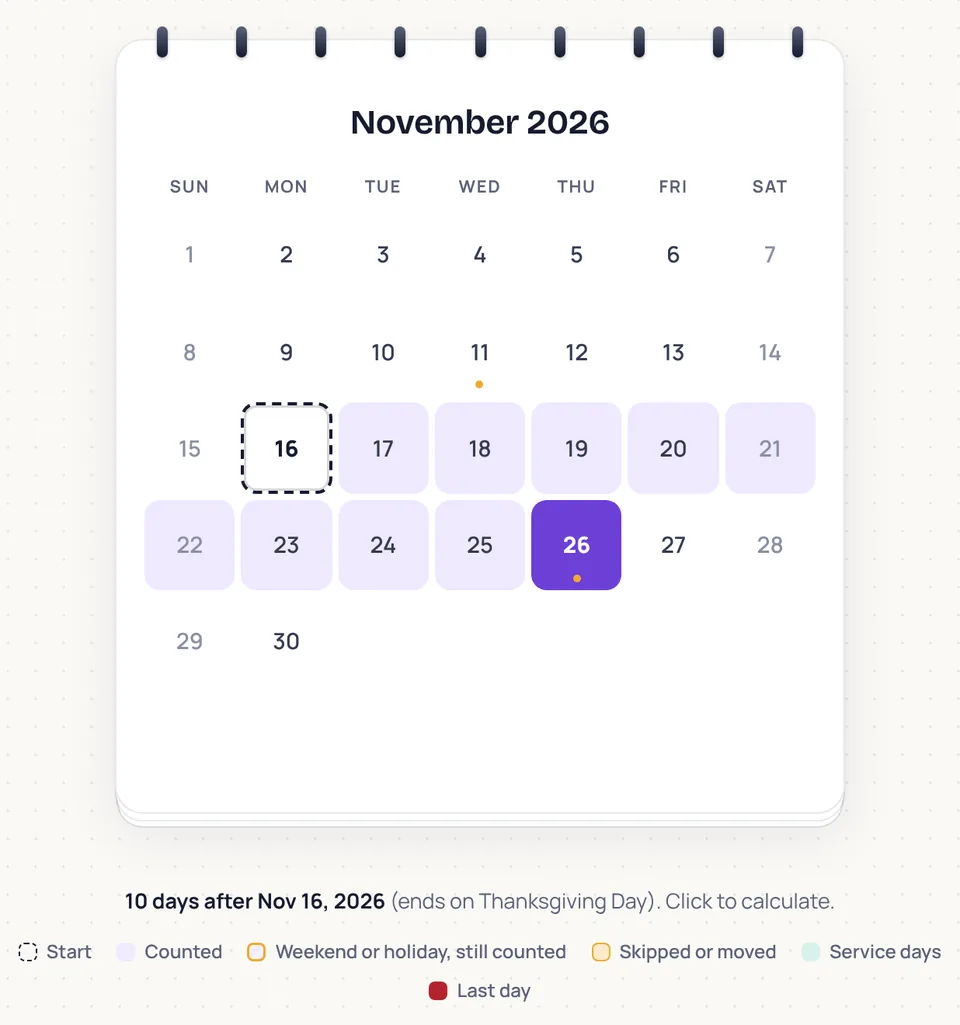
The calendar then flips to the deadline month, lights up each counted day and stamps the last one. Below it, every step is written out with the rule it comes from, so you can check the working instead of trusting a number.
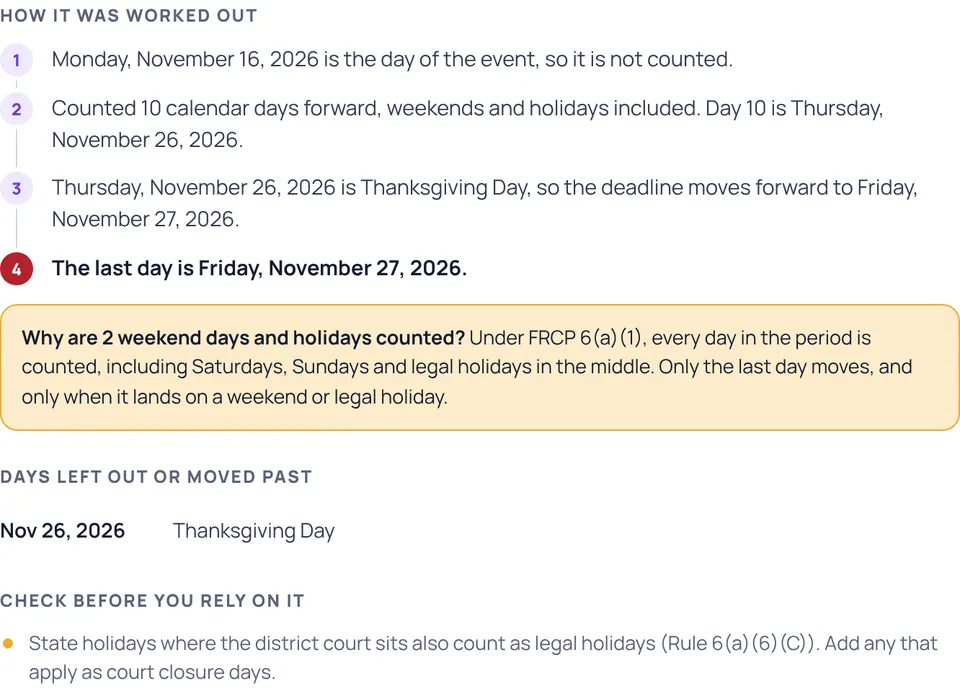
You can add the deadline to your calendar with reminders a week and a day before, save a PDF record for the file, or copy a link for a colleague. It all runs in your browser, and recent calculations are saved only on your device.
What the calculator does not cover
- Local rules, standing orders and a judge’s own orders, which can set different deadlines.
- State holidays for federal district courts. Add them as extra closure days.
- Deemed dates of service under the CPR, such as the day a document sent by post is treated as served.
- Tolling and the other exceptions to limitation periods.
Tools like this on your own website
A tool people use every week gives them a reason to come back to your site. If your firm wants a fast, custom website with its own calculators or intake forms, that is the work I do. See my WordPress development service or get in touch.
Frequently asked questions
Do weekends count in a court deadline?
It depends on the court. In US federal courts every day counts, and only a last day that falls on a weekend or legal holiday moves. In California, weekends count in a period of calendar days but not in a period of court days. In England and Wales, weekends are left out of periods of 5 days or less and counted in longer ones.
What happens if a deadline falls on a holiday?
In all three courts the deadline moves to the next day the court is open. In England and Wales this applies to steps taken at the court office.
What is a court day in California?
A day the court is open. Saturdays, Sundays and the judicial holidays listed in Code of Civil Procedure section 135 are not court days.
What are clear days under CPR 2.8?
Clear days leave out the day the period starts and, when the period ends with an event such as a hearing, the day of that event too.
Is the court deadline calculator free?
Yes. There is no signup, and everything is worked out in your browser.
Can I rely on the result?
Use it as a check. Local rules, standing orders and court orders can change a deadline, so confirm the date against the rule and the court’s calendar before you rely on it.
Senior WordPress and Shopify developer with nine years of experience building and maintaining websites for businesses and agencies worldwide.
More about me